From: $1,345.00
The Tumor-Associated Glycan (TAG) Array is developed to help researchers explore interactions between cancer-associated glycans and glycan-binding molecules. The array contains 84 structurally defined tumor-associated glycans and lycopeptides representing key glycan motifs frequently altered in cancer, including truncated O-glycans (Tn, STn, T, and ST antigens), mucin-derived glycopeptides (MUC1 and MUC16 epitopes), sialyl-Lewis antigens associated with CA19-9, gangliosides, Globo-H, SSEA antigens, Neu5Gc-containing glycans, sTRA structures, and cancer associated complex N-glycans. These structures collectively capture the diversity of glycan epitopes implicated in tumor progression, immune recognition, and cancer diagnostics.
The array is designed for high-resolution characterization of glycan-binding specificity and can be used with a wide range of biological samples, including antibodies, lectins, recombinant proteins, serum samples, cell lysates, extracellular vesicles, bacteria, and viral particles. Multiple identical subarrays are created on each slide, enabling parallel analysis of several samples in a single experiment while requiring only minimal sample volume. The platform offers a simple experimental workflow and produces reproducible, high-throughput binding data suitable for both exploratory research and translational studies.
The TAG microarray can also be customized to include additional glycans or glycopeptides tailored to specific cancer types or research needs. Glycan array screening services are available upon request.
Aberrant glycosylation is a near-universal feature of malignant transformation and progression, producing recurring tumor-associated carbohydrate antigens (TACAs) that are functionally implicated in tumor growth, immune modulation, invasion, and metastasis, and that also underpin multiple clinically used markers and emerging drug targets.
The Tumor-Associated Glycan (TAG) Microarray is a cancer-focused, structure-defined glycan microarray designed to rapidly map and de-risk glycan recognition, especially antibody specificity and cross-reactivity against a curated panel of 84 tumor-associated glycans and glycopeptides. It uses the well-established glycan microarray paradigm to deliver actionable binding profiles with minimal sample consumption and high throughput.
The TAG panel is anchored in (i) clinically established carbohydrate antigens and biomarker contexts (CA15-3/MUC1, CA19-9/sialyl-Lewis A, CA125/MUC16, AFP-L3), (ii) metastasis-relevant selectin ligands and related terminal motifs (sLeA/sLeX, and sTRA programs), (iii) glycolipid TACAs (gangliosides, Globo-H and SSEA motifs), (iv) Neu5Gccontaining “xeno-autoantigen” glycans relevant to tumor immunology and translation between model systems, and (v) cancer-associated N-glycan remodeling motifs (core fucosylation, branched N-glycans) that recur across tumor types.
Array composition
The 84 targets in this TAG panel are distributed across 13 practical “TAG classes” (as defined in the provided list), spanning precursors, clinical marker-associated glycopeptides/glycans, glycolipid epitopes, and cancer-associated N-glycan motifs. This mirrors the “nonrandom” nature of cancer glycosylation changes, where a limited subset of glycan alterations repeatedly emerges across tumor types and is selected during progression.
Table 1. Categories of Tumor-Associated Glycan and Glycopeptide Antigens Included in the Panel.
| Category | Components (exact names) |
|---|---|
| Truncated O-glycans (Tn/STn/T/ST) | Tn-Ser; STn-Ser; T-Ser; ST-Ser |
| Mucin glycopeptides (MUC1/CA15-3) | MUC1; MUC2; MUC3; MUC4; MUC5; MUC6; MUC7; MUC8; MUC9; MUC10; MUC11; MUC12; MUC13; MUC14; MUC15; MUC32; MUC33; MUC34; MUC35; MUC36; MUC37; MUC38; MUC39; MUC40; MUC41; MUC42; MUC43; MUC44; MUC45; MUC46; MUC63 |
| Mucin glycopeptides (MUC16/CA125) | M16-UG; M16-T-Tn; M16-S-Tn; M16-T-STn; M16-S-STn; M16-Bis-Tn; M16-Bis-STn |
| Sialyl-Lewis/CA19-9 family | SLeA; SLeA on Lac; SLeA on LacNAc |
| sTRA family | Ac3-T1-T2-LN (sTRA); A3-G2-T1-LN (sTRA on N-glycan); sTRA on Lac; sTRA on Core 1 O-glycan; sTRA on Core 2 O-glycan; SLeC |
| Gangliosides & glycosphingolipids | GM1; FucGM1; GM2; GM3; GD1a; GD1b; GD2; GD3; Globo-H |
| Globo series & SSEA antigens | SSEA-1 (LeX); SSEA-3 (Gb5); SSEA-4 (AcGb5); SLeX |
| Globo series & Forssman antigen | Forssman antigen pentaose |
| Neu5Gc-containing glycans | GcGM1; GcGM2; GcGM3; Gc2GD1b; Gc2GD2; Gc2GD3 |
| Complex N-glycans (core-fucosylated; AFP-L3-related) | G0F; G2F; G2S2(3)F; G2S2(6)F |
| Complex N-glycans (β1,6-branching/MGAT5-related) | G(6)30; G(6)3; G(6)3S3(3); G(6)3S3(6) |
| Other tumor-associated motifs (LacdiNAc) | LacdiNAc |
| Precursor/core structures (lacto-series) | LNT; LNnT; LsTa; A3LNnT |
Category relevance in cancer
Truncated O-glycans (Tn, sTn, T, sT).
Cancer commonly features impaired O-glycan elongation, exposing truncated mucintype O-glycans such as Tn and sTn; mechanistically this can involve disruption of core-1 extension machinery (e.g., Cosmc/T-synthase axis). Clinically and biologically, these epitopes are widely reported across epithelial cancers and can modulate immune recognition and tumor microenvironment interactions.
Known binders include Tn-binding lectins (e.g., VVA) and O-glycan–specific antibodies; immune lectins such as macrophage galactose-type lectins have also been implicated in Tn-driven immunomodulation.
Mucin glycopeptides (MUC1/CA15-3) and (MUC16/CA125).
Tumor-associated MUC1 is frequently overexpressed and aberrantly glycosylated, with shortened O-glycans (Tn/T/sTn/sT) contributing to tumor-specific epitopes and immune exposure. CA15-3 (and related assays) are used clinically for breast cancer monitoring rather than population screening, reflecting both biological and specificity constraints.
CA125/MUC16 remains foundational for ovarian cancer management (monitoring and clinical evaluation), while ongoing work aims to improve sensitivity/specificity and interpret biological heterogeneity.
Sialyl-Lewis/CA19-9 family (sLeA/CA19-9, sLeX, and related scaffolds).
sLeA (CA19-9) is among the most frequently used serum tumor markers in digestive organ cancers, particularly pancreaticobiliary disease contexts, though its performance is limited by benign inflammation and patient genetics. A critical clinical caveat is that Lewis-negative individuals can have low/absent CA19-9 and thereby false-negative
results. Functionally, sLeA and sLeX are selectin ligands implicated in adhesion/rolling on endothelium during metastasis.
sTRA family (sialylated tumor-related antigen).
sTRA has been reported as a glycan biomarker defining PDAC subpopulations that can complement CA19-9 and provide diagnostic/biological stratification. Importantly, sTRA can be displayed on different scaffolds (free glycan motif, O-glycan cores, N-glycan contexts), and the array’s multi-scaffold design helps discriminate true epitope specificity versus scaffold-driven binding.
Gangliosides/glycosphingolipids and globo-series/SSEA motifs (including GloboH).
Tumor-associated gangliosides and globo-series glycosphingolipids influence signalling, immune modulation, and tumor aggressiveness; specific gangliosides can be enriched in defined tumor types. The therapeutic relevance is strongest for GD2 (validated antibody target in neuroblastoma) and for emerging targets like fucosyl-GM1 in small cell lung cancer. Globo-H and SSEA-3/4 are globo-series TACAs reported across multiple epithelial tumors and linked to stem-like phenotypes and tumor progression pathways.
Neu5Gc-containing glycans, AFP-L3-related core fucosylation, MGAT5-related β1,6 branching, and LacdiNAc.
Neu5Gc is a non-human sialic acid that can accumulate in human tumors, with evidence supporting dietary uptake and inflammation-related tumor promotion via circulating anti-Neu5Gc antibodies. AFP-L3 reflects core-fucosylated AFP and is used clinically to support hepatocellular carcinoma evaluation (often alongside AFP and other markers). β1,6-GlcNAc branching (MGAT5/GnT-V) is a recurrent cancer-associated N- glycan remodeling axis linked to tumor progression and metastasis. LacdiNAc motifs are associated with malignancy in multiple cancers.
Assay format and compatibility.
Each slide is available with 8 or 16 identical subarrays, supporting parallel analysis of multiple samples on one slide while conserving sample volume. The TAG Microarray can be used with a wide range of samples, including purified antibodies, lectins, recombinant proteins, patient sera (for anti-glycan antibody profiling), cell lysates, and other complex mixtures where glycan-binding specificity is a central question.
Typical benefits (without performance fabrication).
Glycan microarrays are valued because they help (i) resolve specificity vs crossreactivity across closely related pitopes, (ii) discriminate scaffold effects using structurally controlled targets, and (iii) generate systematic binding profiles that translate directly into assay development decisions. This is particularly important for tumor glycan targets, where clinically used markers (e.g., CA19-9) have known biological and genetic limitations and where off-target glycan binding can drive false positives or unsafe targeting.
Customization and screening services.
Custom arrays can be created by adding/removing glycans, expanding scaffoldcoverage (e.g., more mucin or glycolipid contexts), or prioritizing tumor-type–specific targets (e.g., pancreatic-focused CA19-9/sTRA panels; neuroblastoma GD2-focused panels). The array is conceptually aligned with community glycan-array standards established by the Consortium for Functional Glycomics and related centers such as the National Center for Functional Glycomics, enabling interpretation in the context of widely used glycan-array workflows and datasets.
Intended applications.
The TAG Microarray is designed for biomarker discovery and validation (e.g., CA19-9-related markers, sTRA), antibody specificity mapping (e.g., anti-Tn, anti-GD2, antiGlobo-H), lectin profiling, CAR-T target plausibility checks (epitope selectivity assessment), and immune monitoring of anti-glycan antibody responses (e.g., Neu5Gcassociated xeno-autoantigens).
Key Features
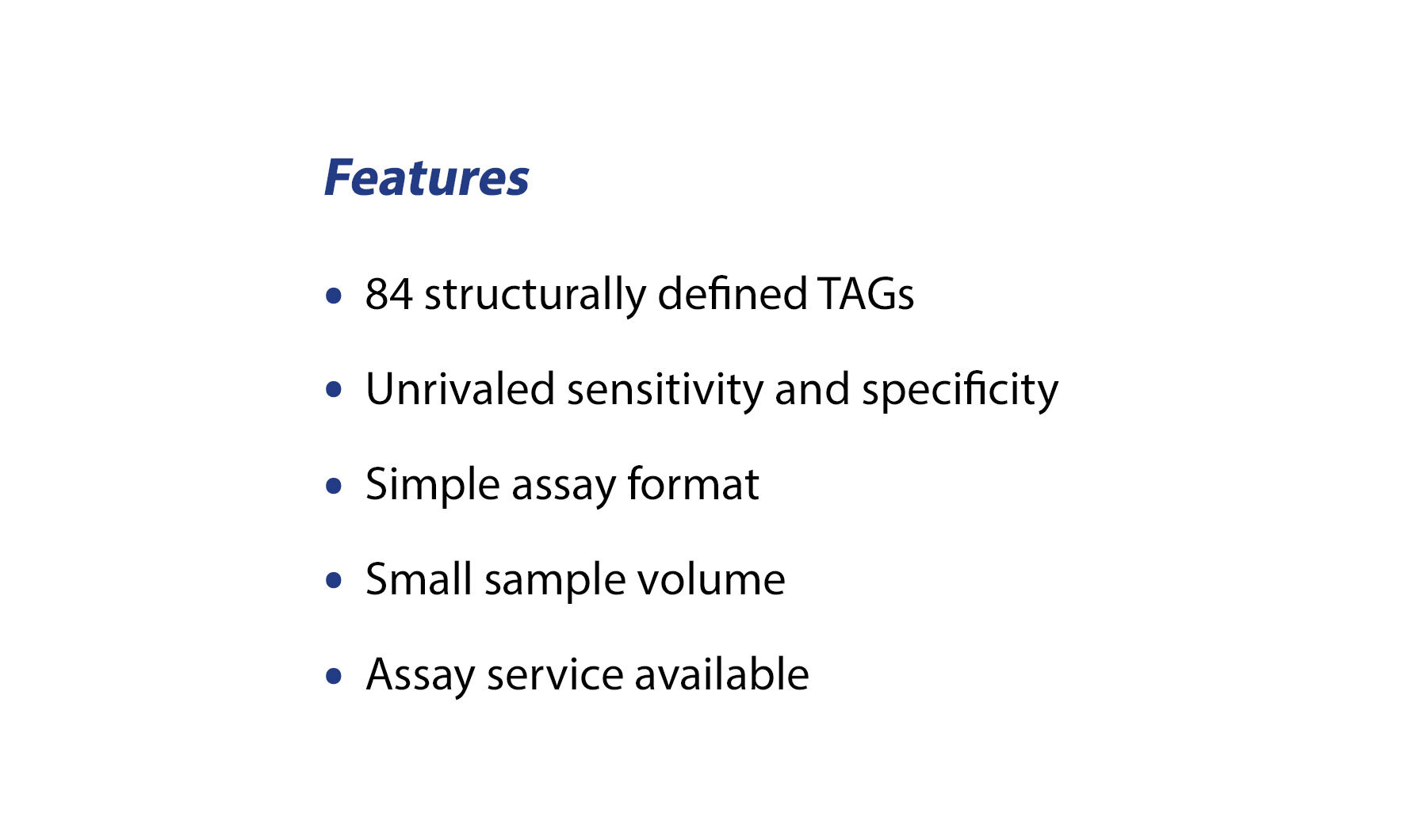
– Curated panel of 84 tumor-associated glycans and glycopeptides spanning major cancer glycan classes.
– Multi-scaffold epitope coverage (minimal motifs, extended chains, mucin glycopeptides, glycosphingolipid headgroups, N-glycan contexts) to test context dependence.
– High-throughput glycan–binder profiling using established fluorescence microarray workflows.
– Supports cross-reactivity assessment among closely related TACAs (e.g., sLeA vs sLeX vs SLeC; Neu5Ac vs Neu5Gc counterparts).
– Formats with 8 or 16 identical subarrays per slide for efficient multi-sample screening.
– Customization and assay services available for project-specific target panels.
Applications
– Cancer biomarker discovery and validation (including CA19-9-family and sTRA-related programs).
– Antibody specificity and cross-reactivity testing for tumor glycans (e.g., Tn/sTn, GD2, Globo-H).
– Lectin profiling and glyco-phenotyping of tumor-associated motifs (e.g., VVA for Tn; MAL/SNA for α2-3/α2-6 sialylation; WFA for LacdiNAc).
– CAR-T / cell-therapy target validation support via epitope-level binding specificity checks (e.g., GD2, SSEA-4).
– Immune monitoring of anti-glycan antibody responses (including Neu5Gc-associated xeno-autoantigens).
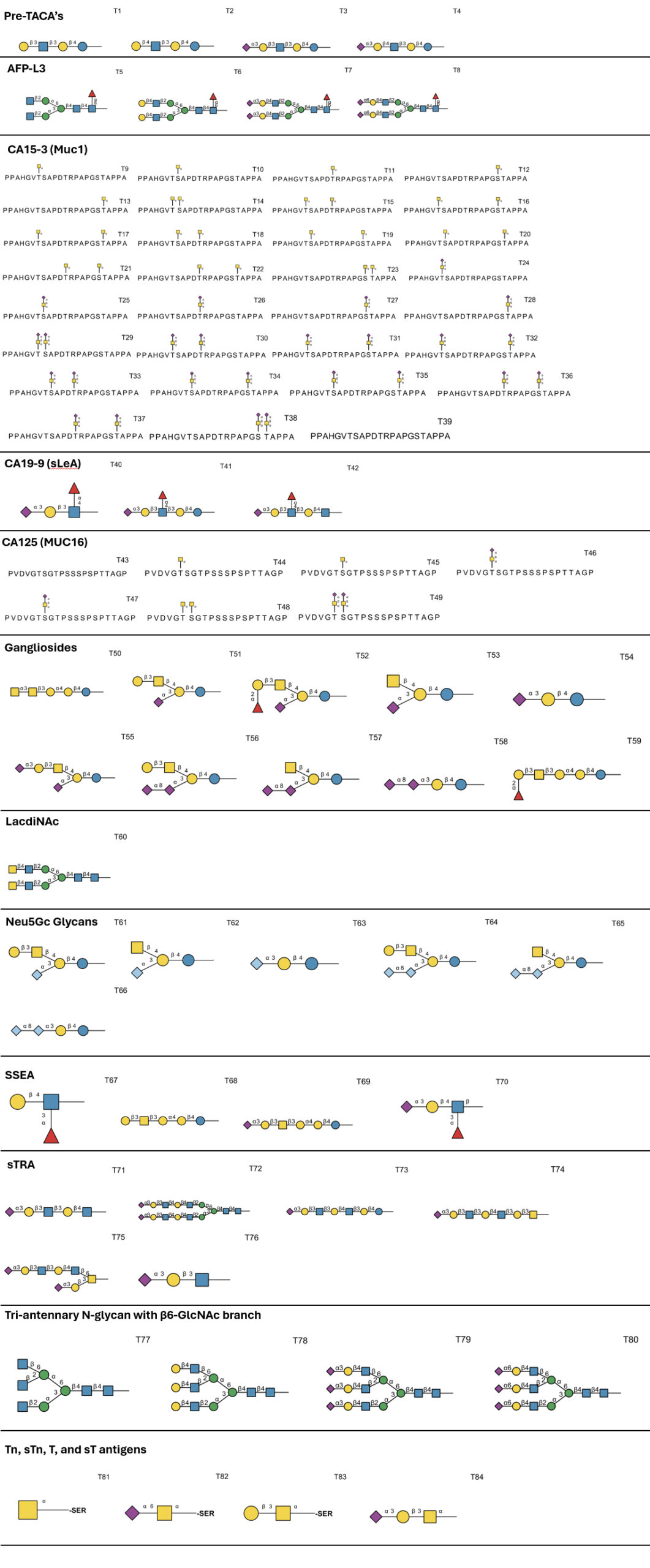
List of Tumor-Associated Glycan structures on the array (download the PDF)

| TAG Class | ID | Name | Text Structure |
|---|---|---|---|
| Pre-TACAs | T1 | LNT | Galβ1-3GlcNAcβ1-3Galβ1-4Glc |
| T2 | LNnT | Galβ1-4GlcNAcβ1-3Galβ1-4Glc | |
| T3 | LsTa | Neu5Acα2-3Galβ1-3GlcNAcβ1-3Galβ1-4Glc | |
| T4 | A3LNnT | Neu5Acα2-3Galβ1-4GlcNAcβ1-3Galβ1-4Glc | |
| AFP-L3 | T5 | G0F | GlcNAcβ1-2Manα1-6(GlcNAcβ1-2Manα1-3)Manβ1-4GlcNAcβ1-4(Fucα1-6)GlcNAc- |
| T6 | G2F | Galβ1-4GlcNAcβ1-2Manα1-6(Galβ1-4GlcNAcβ1-2Manα1-3)Manβ1-4GlcNAcβ1-4(Fucα1-6)GlcNAc- | |
| T7 | G2S2(3)F | Neu5Acα2-3Galβ1-4GlcNAcβ1-2Manα1-6(Neu5Acα2-3Galβ1-4GlcNAcβ1-2Manα1-3)Manβ1-4GlcNAcβ1-4(Fucα1-6)GlcNAc- | |
| T8 | G2S2(6)F | Neu5Acα2-6Galβ1-4GlcNAcβ1-2Manα1-6(Neu5Acα2-6Galβ1-4GlcNAcβ1-2Manα1-3)Manβ1-4GlcNAcβ1-4(Fucα1-6)GlcNAc- | |
| CA15-3 (MUC1) | T9 | MUC1 | NH2-PPAHGV{GalNAca}TSAPDTRPAPGSTAPPA-OH |
| T10 | MUC2 | NH2-PPAHGVT{GalNAca}SAPDTRPAPGSTAPPA-OH | |
| T11 | MUC3 | NH2-PPAHGVTSAPD{GalNAca}TRPAPGSTAPPA-OH | |
| T12 | MUC4 | NH2-PPAHGVTSAPDTRPAPG{GalNAca}STAPPA-OH | |
| T13 | MUC5 | NH2-PPAHGVTSAPDTRPAPGS{GalNAca}TAPPA-OH | |
| T14 | MUC6 | NH2-PPAHGV{GalNAca}T{GalNAca}SAPDTRPAPGSTAPPA-OH | |
| T15 | MUC7 | NH2-PPAHGV{GalNAca}TSAPD{GalNAca}TRPAPGSTAPPA-OH | |
| T16 | MUC8 | NH2-PPAHGV{GalNAca}TSAPDTRPAPG{GalNAca}STAPPA-OH | |
| T17 | MUC9 | NH2-PPAHGV{GalNAca}TSAPDTRPAPGS{GalNAca}TAPPA-OH | |
| T18 | MUC10 | NH2-PPAHGVT{GalNAca}SAPD{GalNAca}TRPAPGSTAPPA-OH | |
| T19 | MUC11 | NH2-PPAHGVT{GalNAca}SAPDTRPAPG{GalNAca}STAPPA-OH | |
| T20 | MUC12 | NH2-PPAHGVT{GalNAca}SAPDTRPAPGS{GalNAca}TAPPA-OH | |
| T21 | MUC13 | NH2-PPAHGVTSAPD{GalNAca}TRPAPG{GalNAca}STAPPA-OH | |
| T22 | MUC14 | NH2-PPAHGVTSAPD{GalNAca}TRPAPGS{GalNAca}TAPPA-OH | |
| T23 | MUC15 | NH2-PPAHGVTSAPDTRPAPG{GalNAca}S{GalNAca}TAPPA-OH | |
| T24 | MUC32 | NH2-PPAHGV{Neu5Aca2-6GalNAca}TSAPDTRPAPGSTAPPA-OH | |
| T25 | MUC33 | NH2-PPAHGVT{Neu5Aca2-6GalNAca}SAPDTRPAPGSTAPPA-OH | |
| T26 | MUC34 | NH2-PPAHGVTSAPD{Neu5Aca2-6GalNAca}TRPAPGSTAPPA-OH | |
| T27 | MUC35 | NH2-PPAHGVTSAPDTRPAPG{Neu5Aca2-6GalNAca}STAPPA-OH | |
| T28 | MUC36 | NH2-PPAHGVTSAPDTRPAPGS{Neu5Aca2-6GalNAca}TAPPA-OH | |
| T29 | MUC37 | NH2-PPAHGV{Neu5Aca2-6GalNAca}T{Neu5Aca2-6GalNAca}SAPDTRPAPGSTAPPA-OH | |
| T30 | MUC38 | NH2-PPAHGV{Neu5Aca2-6GalNAca}TSAPD{Neu5Aca2-6GalNAca}TRPAPGSTAPPA-OH | |
| T31 | MUC39 | NH2-PPAHGV{Neu5Aca2-6GalNAca}TSAPDTRPAPG{Neu5Aca2-6GalNAca}STAPPA-OH | |
| T32 | MUC40 | NH2-PPAHGV{Neu5Aca2-6GalNAca}TSAPDTRPAPGS{Neu5Aca2-6GalNAca}TAPPA-OH | |
| T33 | MUC41 | NH2-PPAHGVT{Neu5Aca2-6GalNAca}SAPD{Neu5Aca2-6GalNAca}TRPAPGSTAPPA-OH | |
| T34 | MUC42 | NH2-PPAHGVT{Neu5Aca2-6GalNAca}SAPDTRPAPG{Neu5Aca2-6GalNAca}STAPPA-OH | |
| T35 | MUC43 | NH2-PPAHGVT{Neu5Aca2-6GalNAca}SAPDTRPAPGS{Neu5Aca2-6GalNAca}TAPPA-OH | |
| T36 | MUC44 | NH2-PPAHGVTSAPD{Neu5Aca2-6GalNAca}TRPAPG{Neu5Aca2-6GalNAca}STAPPA-OH | |
| T37 | MUC45 | NH2-PPAHGVTSAPD{Neu5Aca2-6GalNAca}TRPAPGS{Neu5Aca2-6GalNAca}TAPPA-OH | |
| T38 | MUC46 | NH2-PPAHGVTSAPDTRPAPG{Neu5Aca2-6GalNAca}S{Neu5Aca2-6GalNAca}TAPPA-OH | |
| T39 | MUC63 | NH2-PPAHGVTSAPDTRPAPGSTAPPA-OH | |
| CA19-9 (SLeA) | T40 | SLeA | Neu5Acα2-3Galβ1-3[Fucα1-4]GlcNAc |
| T41 | SLeA on Lac | Neu5Acα2-3Galβ1-3[Fucα1-4]GlcNAcβ1-3Galβ1-4Glc- | |
| T42 | SLeA on LacNAc | Neu5Acα2-3Galβ1-3[Fucα1-4]GlcNAcβ1-3Galβ1-4GlcNAc- | |
| Forssman antigen | T50 | Forssman antigen pentaose | GalNAcα1-3GalNAcβ1-3Galα1-4-Galβ1-4Glc- |
| Gangliosides | T51 | GM1 | Neu5Acα2-3(Galβ1-3GalNAcβ1-4)Galβ1-4Glc- |
| T52 | FucGM1 | Fucα1-2Galβ1-3GalNAcβ1-4(Neu5Acα2-3)Galβ1-4Glc- | |
| T53 | GM2 | Neu5Acα2-3(GalNAcβ1-4)Galβ1-4Glc- | |
| T54 | GM3 | Neu5Acα2-3Galβ1-4Glc- | |
| T55 | GD1a | Neu5Acα2-3Galβ1-3GalNAcb1-4(Neu5Aca2-3)Galβ1-4Glc- | |
| T56 | GD1b | Neu5Acα2-8Neu5Acα2-3(Galβ1-3GalNAcβ1-4)Galβ1-4Glc- | |
| T57 | GD2 | Neu5Acα2-8Neu5Acα2-3(GalNAcβ1-4)Galβ1-4Glc- | |
| T58 | GD3 | Neu5Acα2-8Neu5Acα2-3Galβ1-4Glc- | |
| T59 | Globo-H | Fucα1-2Galβ1-3GalNAcβ1-3Galα1-4Galβ1-4Glc- | |
| LacdiNAc | T60 | LacdiNAc | GalNAcb1-4GlcNAcb1-2Mana1-6(GalNAcb1-4GlcNAcb1-2Mana1-3)Manb1-4GlcNAcb1-4GlcNAc |
| Neu5Gc Glycans | T61 | GcGM1 | Neu5Gcα2-3(Galβ1-3GalNAcβ1-4)Galβ1-4Glc- |
| T62 | GcGM2 | Neu5Gcα2-3(GalNAcβ1-4)Galβ1-4Glc- | |
| T63 | GcGM3 | Neu5Gcα2-3Galβ1-4Glc- | |
| T64 | Gc2GD1b | Neu5Gcα2-8Neu5Gcα2-3(Galβ1-3GalNAcβ1-4)Galβ1-4Glc- | |
| T65 | Gc2GD2 | Neu5Gcα2-8Neu5Gcα2-3(GalNAcβ1-4)Galβ1-4Glc- | |
| T66 | Gc2GD3 | Neu5Gcα2-8Neu5Gcα2-3Galβ1-4Glc- | |
| SSEA | T67 | SSEA-1 (LeX) | Galβ1-4(Fucα1-3)GlcNAc- |
| T68 | SSEA-3 (Gb5) | Galβ1-3GalNAcβ1-3Galα1-4Galβ1-4Glc- | |
| T69 | SSEA-4 (AcGb5) | Neu5Aca2-3Galb1-3GalNAcb1-3Gala1-4Galb1-4Glc- | |
| T70 | SLeX | Neu5Acα2-3Galβ1-4(Fucα1-3)GlcNAcβ- | |
| sTRA | T71 | Ac3-T1-T2-LN (sTRA) | Neu5Acα2-3Galβ1-3GlcNAcβ1-3Galβ1-4GlcNAc |
| T72 | A3-G2-T1-LN (sTRA on N-glycan) | Neu5Aca2-3Galb1-3GlcNAcb1-4Galb1-4GlcNAcb1-2Mana1-6(Neu5Aca2-3Galb1-3GlcNAcb1-4Galb1-4GlcNAcb1-2Mana1-3)Manb1-4GlcNAcb1-4GlcNAc | |
| T73 | sTRA on Lac | Neu5Acα2-3Galβ1-3GlcNAcβ1-3Galβ1-4GlcNAcβ1-3Galβ1-4Glc- | |
| T74 | sTRA on Core 1 O-glycan | Neu5Acα2-3Galβ1-3GlcNAcβ1-3Galβ1-4GlcNAcβ1-3Galβ1-3GalNAc- | |
| T75 | sTRA on Core 2 O-glycan | Neu5Acα2-3Galβ1-3GlcNAcβ1-3Galβ1-4GlcNAcβ1-6(Neu5Acα2-3Galβ1-3)GalNAc | |
| T76 | SLeC | Neu5Acα2-3Galβ1-3GlcNAc | |
| Tri-antennary N-glycan with β6-GlcNAc branch | T77 | G(6)30 | (GlcNAcβ1-2(GlcNAcβ1-6)Manα1-6)(GlcNAcβ1-2Manα1-3)Manβ1-4GlcNAcβ1-4GlcNAc- |
| T78 | G(6)3 | (Galβ1-4GlcNAcβ1-2(Galβ1-4GlcNAcβ1-6)Manα1-6)(Galβ1-4GlcNAcβ1-2Manα1-3)Manβ1-4GlcNAcβ1-4GlcNAc- | |
| T79 | G(6)3S3(3) | (Neu5Acα2-3Galβ1-4GlcNAcβ1-2(Neu5Acα2-3Galβ1-4GlcNAcβ1-6)Manα1-6)(Neu5Acα2-3Galβ1-4GlcNAcβ1-2Manα1-3)Manβ1-4GlcNAcβ1-4GlcNAc- | |
| T80 | G(6)3S3(6) | (Neu5Acα2-6Galβ1-4GlcNAcβ1-2(Neu5Acα2-6Galβ1-4GlcNAcβ1-6)Manα1-6)(Neu5Acα2-6Galβ1-4GlcNAcβ1-2Manα1-3)Manβ1-4GlcNAcβ1-4GlcNAc- | |
| Tn, STn, T, ST antigens | T81 | Tn-Ser | GalNAcα-Ser |
| T82 | STn-Ser | Neu5Acα2-6GalNAcα-Ser | |
| T83 | T-Ser | Galβ1-3GalNAcα-Ser | |
| T84 | ST-Ser | Neu5Acα2-3Galβ1-3GalNAcα-Ser |
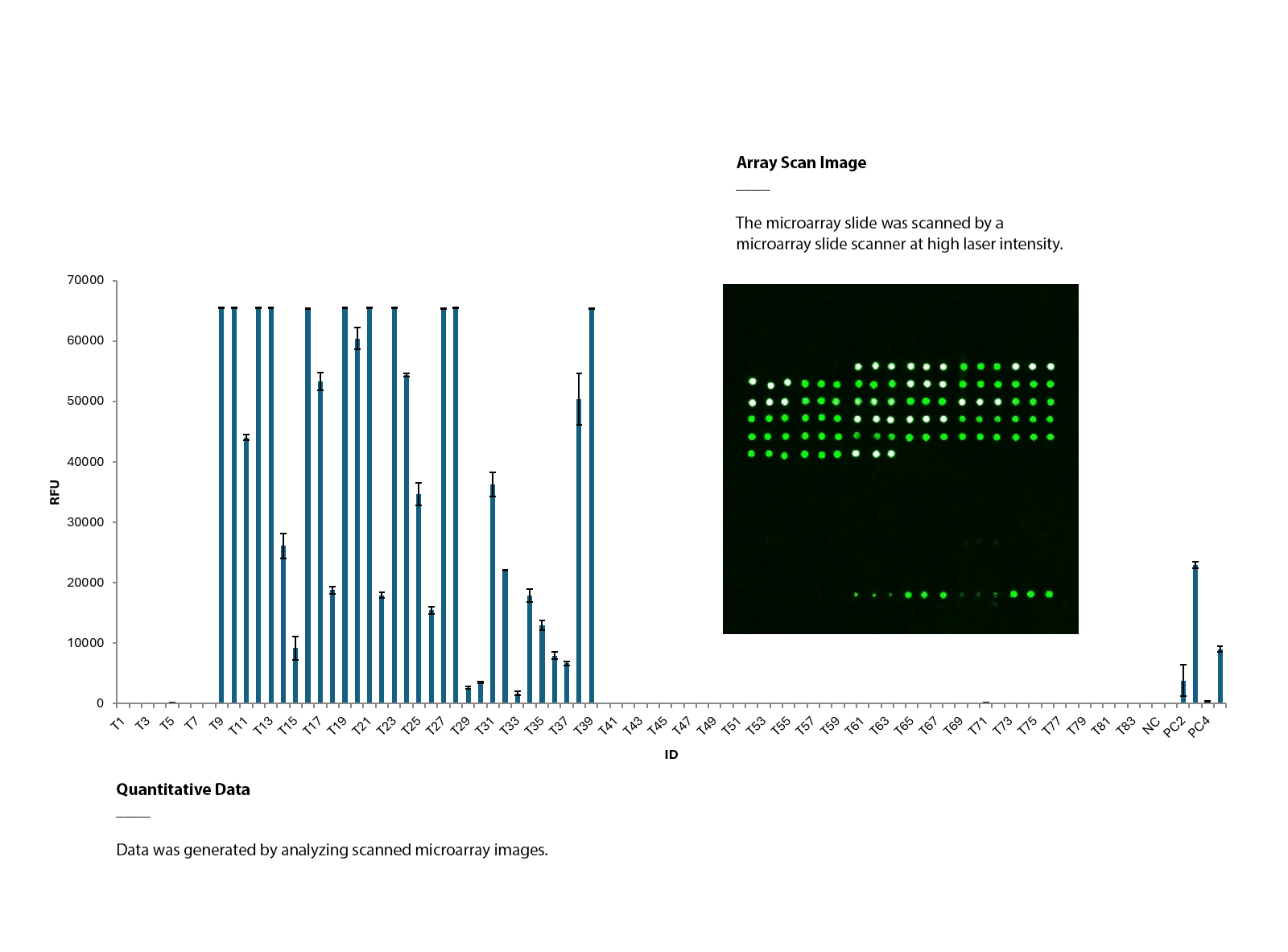
To demonstrate the performance of the Tumor-Associated Glycan (TAG) Array, a panel of well-characterized antibodies targeting clinically relevant tumor-associated carbohydrate antigens was tested across the 84-glycan panel. The array was incubated with each antibody at indicated concentrations followed by fluorescent secondary detection, and the slides were scanned using high laser power to capture the binding signals.
MUC1 Antibody Profiling
The anti-MUC1 antibody displayed strong and selective binding to the MUC1 glycopeptide panel (T9-T39). At 1 µg/mL, high fluorescence signals were observed across most MUC1 peptide variants, including peptides carrying single and multiple GalNAc (Tn antigen) or sialyl-Tn (Neu5Acα2-6GalNAc) modifications. Peak signals exceeded several thousand RFU for multiple glycopeptide variants, indicating strong recognition of the glycosylated MUC1 tandem repeat region. Importantly, binding signals for non-mucin glycans on the array remained near background, confirming that the antibody specifically recognizes the MUC1 glycopeptide scaffold rather than isolated glycan motifs.

CA19-9 Antibody Specificity
The CA19-9 antibody showed strong binding to glycans containing the sialyl-Lewis A (SLeA) epitope. At 5 µg/mL, the highest signals were observed for glycans T40–T42, which represent SLeA structures presented in different glycan contexts. These signals were significantly higher than background signals observed for unrelated glycans across the array. Additional moderate signals were detected on related glycans that contain similar terminal motifs, but the overall binding pattern clearly clustered around the SLeA-containing structures.

Forssman antigen antibody
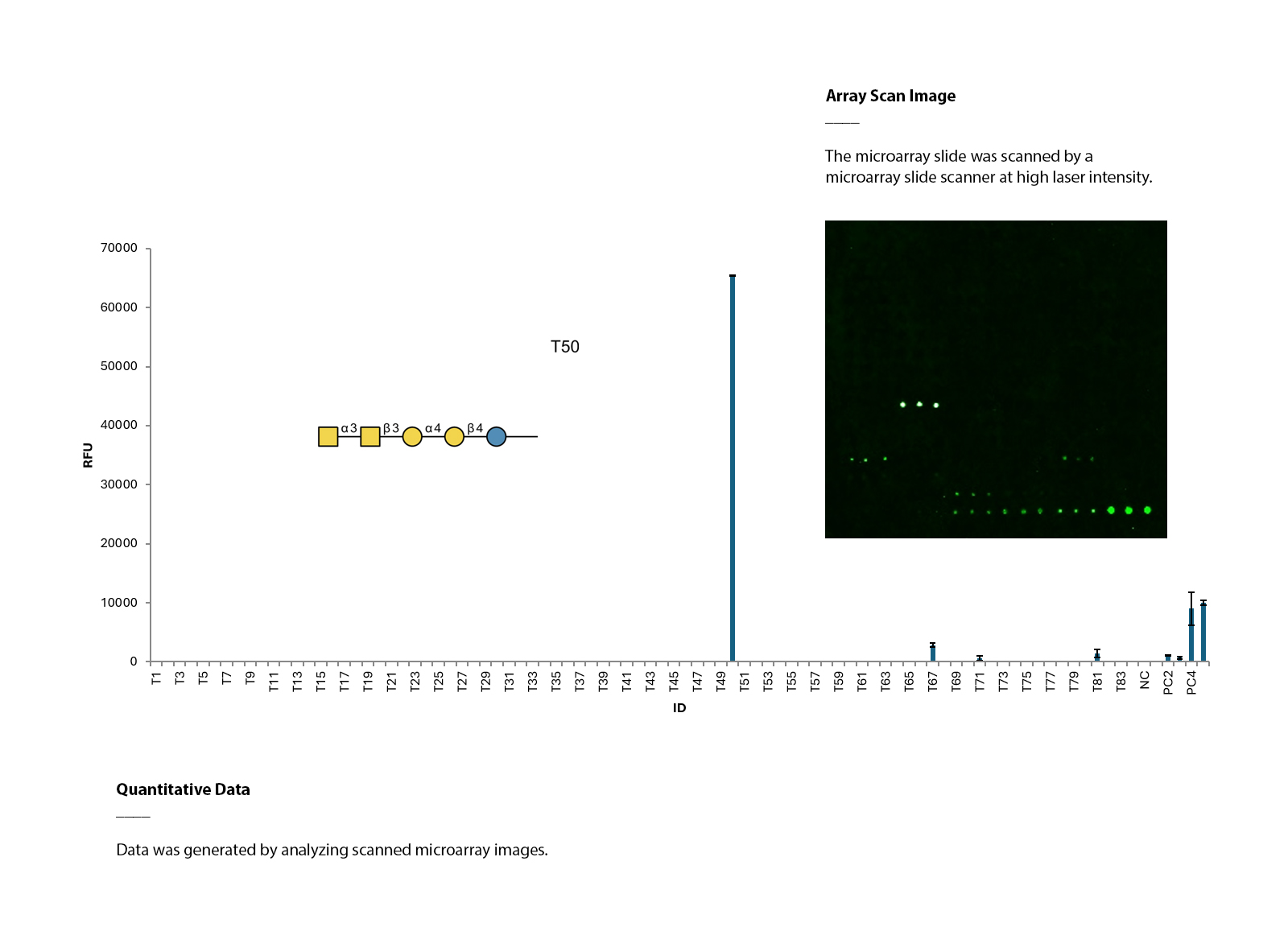
The Forssman antigen is a pentasaccharide glycolipid, which is normally absent from most human tissues but can be aberrantly expressed in certain cancers and tumorderived cell lines. When the anti-Forssman antibody (10 µg/mL ) was applied to the TAG array, a strong and highly selective binding signal was observed at the Forssman antigen spot (T50). In contrast, most other glycans on the array, including structurally related glycosphingolipids such as GM1, GM2, GM3, GD2, and GD3, produced only background-level signals. This selective binding pattern demonstrates that the TAG Array can clearly distinguish the Forssman antigen from other closely related glycan structures.

List of Glycan Structures in the Tumor-Associated Glycan Array (download the manual)


Reviews
There are no reviews yet.