Unlocking the Target Behind NEO-201

ZBiotechTHERAPY & DIAGNOSTICSUnlocking the Target Behind NEO-201
THERAPY & DIAGNOSTICS

Unlocking the Target Behind NEO-201

Enabling the Next Generation of Glyco-Immunotherapy

Highlights

Array:O-Glycan Array
Field:Therapy Development
Study:Glycan Binding Specificity

Monoclonal antibodies remain one of the most powerful tools in cancer immunotherapy.Yet identifying the precise molecular targets that distinguish tumor cells from healthy tissues remains a major challenge. Many promising antibodies demonstrate tumor selectivity, but the underlying antigen or epitope responsible for this specificity is often unclear.

A recent study investigating the monoclonal antibody NEO-201 set out to answer exactly that question: what molecular structure does this therapeutic antibody truly recognize on cancer cells? Using glycan profiling technologies, researchers discovered that NEO-201 specifically recognizes tumor-associated O-glycan structures, providing new insight into how this antibody selectively targets a broad range of carcinomas.

The Hidden Language of Cancer: Tumor-Associated O-Glycans

Protein glycosylation, the attachment of complex carbohydrate structures to proteins, plays a critical role in cancer biology. During malignant transformation, normal glycosylation pathways become disrupted, leading to the appearance of truncated Oglycans on the cell surface. Among the most common tumor-associated glycans are: Tn antigen; T antigen (core-1 O-glycan); and extended core-1 structures. These glycans are rarely exposed in healthy tissues but are frequently expressed in epithelial cancers including pancreatic, colorectal, breast, and lung tumors. Because of their tumorrestricted expression, these structures represent highly attractive immunotherapy targets. However, identifying which specific glycan epitope an antibody recognizes requires powerful analytical tools.

The Critical Role of the O-Glycan Microarray

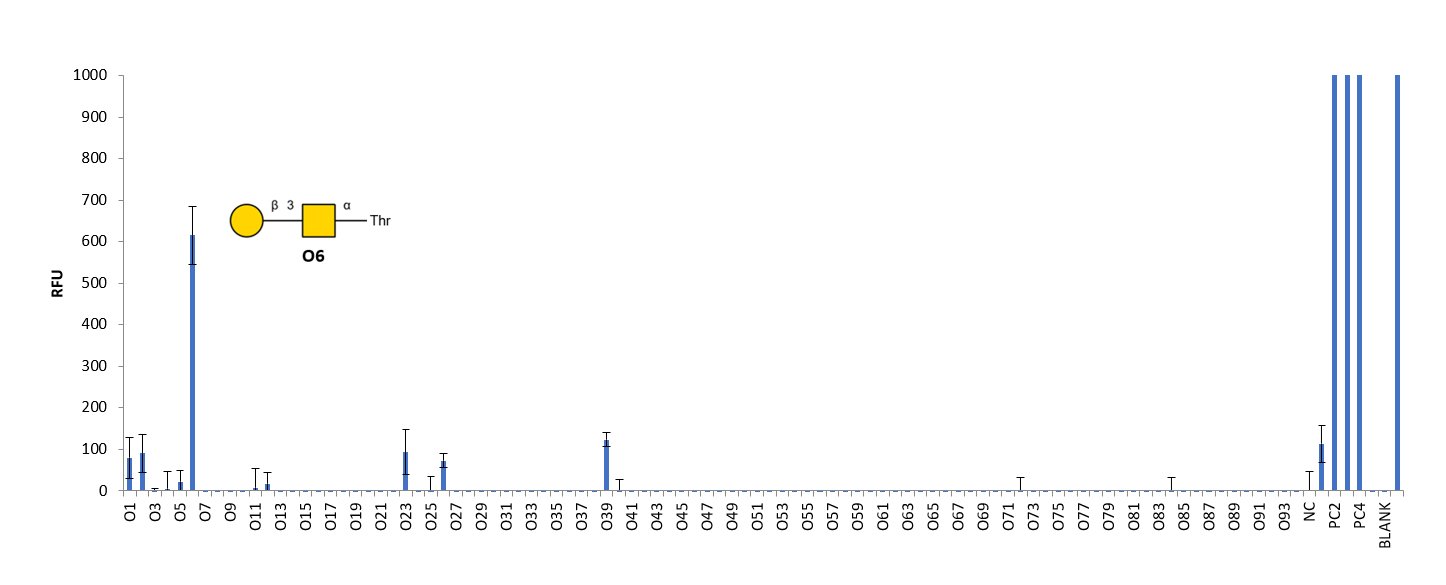
To identify the epitope recognized by NEO-201, researchers used a comprehensive Oglycan microarray containing 94 distinct glycan structures. This high-throughput platform enabled systematic evaluation of antibody binding across a wide spectrum of tumorassociated glycans. Using this array, the team made a crucial discovery. NEO-201 showed strongest binding to core-1 and extended core-1 O-glycans. These glycans are commonly expressed on tumor-associated variants of CEACAM5 and CEACAM6.

Cells lacking these glycans did not bind the antibody. This experiment definitively demonstrated that the true epitope of NEO-201 is a tumor-associated O-glycan motif rather than a protein backbone. Such insights are difficult, if not impossible, to obtain without glycan array technology.

Once the glycan target was identified, the researchers confirmed the biological significance of this interaction. Cancer cell lines expressing core-1 O-glycans showed strong binding to NEO-201, while glycan-negative cells did not. More importantly, the antibody was able to recruit immune effector cells to destroy these tumor cells through antibody-dependent cellular cytotoxicity (ADCC). These findings provide a mechanistic explanation for the broad tumor reactivity previously observed with NEO-201 and support its development as a therapeutic antibody targeting glycosylation abnormalities in cancer.

Figure 1. Binding of monoclonal antibody NEO-201 to an O-glycan array.

Binding profile of the humanized monoclonal antibody NEO-201 against an O-glycan microarray consisting of multiple O-glycan structures (O1–O96). Strong binding was observed to glycan O6, corresponding to the core 1 O-glycan (T antigen; Galβ1-3GalNAcα-Thr), while most other glycans showed minimal or background-level signals. Positive control spots (PC) produced strong fluorescence signals, confirming assay performance, while negative controls remained low. Data are reproduced from Tsang et al. (2022), which utilized our O-glycan microarray platform to identify the glycan epitope recognized by NEO-201.

Why Glycan Arrays Matter for Immunotherapy Discovery

The success of this study highlights an important reality: many tumor-selective antibodies recognize glycan epitopes rather than protein sequences. Without glycan array technology, these targets may remain hidden. Platforms such as the ZBiotech OGlycan Microarray, which contains 94 structurally defined O-glycans, allow researchers to:

– Identify antibody glycan epitopes with high precision
– Differentiate between closely related glycan structures
– Detect cross-reactivity early in therapeutic development
– Accelerate the discovery of tumor-specific glyco-targets

By enabling comprehensive glycan specificity profiling, glycan arrays transform antibody characterization from guesswork into data-driven discovery.

Enabling the Next Generation of Glyco-Immunotherapy

As the field of glyco-immunology continues to grow, understanding tumor glycosylation patterns is becoming increasingly important for therapeutic design.

Studies like this one demonstrate that aberrant glycosylation is not just a cancer hallmark, it is a druggable vulnerability. With tools like the ZBiotech O-Glycan Microarray, researchers can now rapidly map glycan-specific antibody interactions and unlock new targets for cancer immunotherapy. The future of precision oncology may very well lie in decoding the glycan signatures that distinguish tumors from healthy tissue.

Reference

1. Tsang, K. Y. et al. Identification of the O-glycan epitope targeted by the anti-human carcinoma monoclonal antibody (mAb) NEO-201. Cancers 14, 4999 (2022).

2. Fantini, M. et al. Preclinical characterization of a novel monoclonal antibody NEO-201 for the treatment of human carcinomas. Front. Immunol. 8, 1899 (2018).